
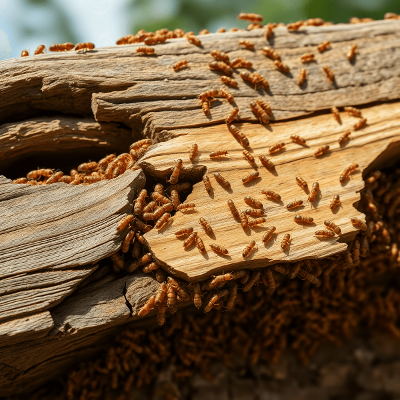
How To Detect Termites
You usually do not think about termites until someone says the word out loud and then suddenly you feel like your house is made of crackers. Because that is kind of the problem.
Termites do not announce themselves. They do not chew loudly. They do not leave obvious clues right away. They just... work. Quietly. Patiently. Sometimes for years. And by the time you notice, the damage is already baked into the structure.
Termites can be a major problem that you cannot afford to ignore. Termites are one of those home issues where denial is expensive.
This shouldn't alarm you if you understand what they are, how they get into your home's skeleton breaking it down, what they do once inside, and what you can do, realistically, to stop them.
The part people miss about termites
The biggest misconception is that termites only show up in old houses, or dirty houses, or houses in the woods. Nope.
Termites show up where there is food, moisture, and access. That is it. And "food" basically means cellulose. Wood. Paper. Cardboard. Drywall paper. Some fabrics. Even that stack of moving boxes you never broke down.
With termites, a lot of homes can have an infestation and look totally fine from the outside.
Fresh paint, nice floors, nothing sagging. Meanwhile a hidden beam is being hollowed out like a straw. That is why they are a hidden menace. The damage is often internal first. Structural. Not cosmetic.
What termites actually are in plain language
Termites are social insects. They live in colonies. They have roles. Workers, soldiers, and reproductives. The workers are the ones doing most of the eating and tunneling. Soldiers defend the colony. Reproductives expand it.
You do not have "a termite." You have a colony nearby. Sometimes a big one0.
Unlike a random ant problem, termites can stay active year round in many climates, especially if they are protected underground or inside heated structures.
Worried about termites? Call 302-875-2725